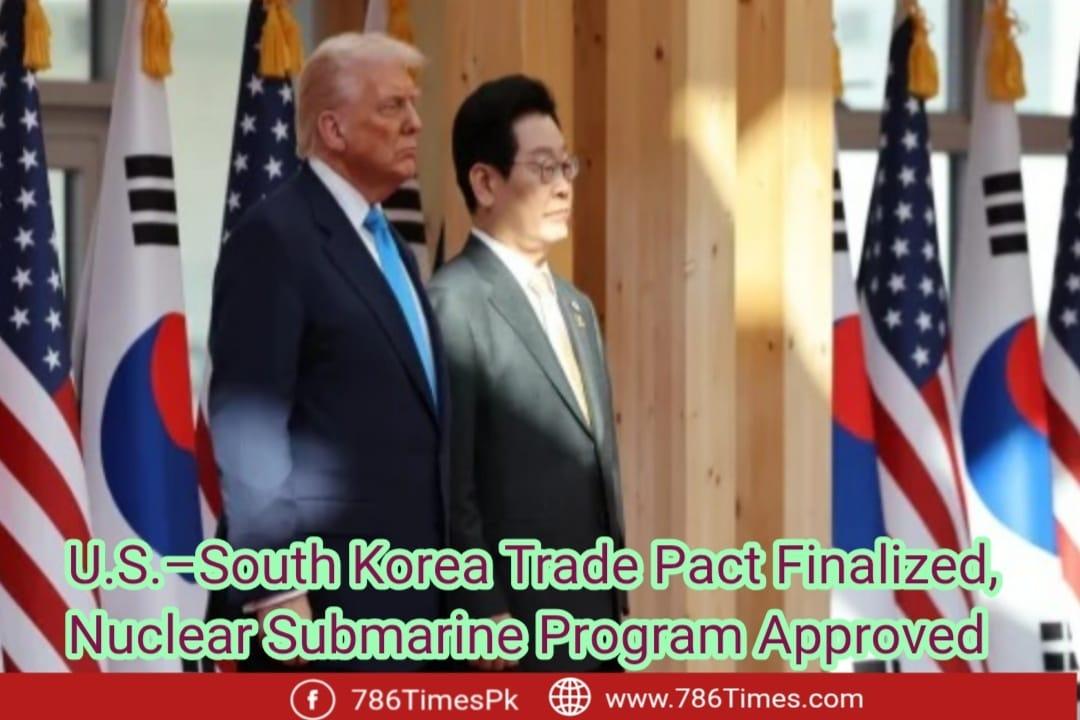
SEUL, Nov. 14, 2025 — The United States and South Korea on Friday released a joint fact sheet finalizing a sweeping trade and security agreement that includes Washington’s approval for Seoul to develop nuclear-powered submarines and a landmark $350 billion investment pledge by South Korea into the U.S. economy.
The accord, finalized after talks between President Donald Trump and President Lee Jae Myung that concluded Oct. 29 at the APEC summit in Gyeongju, represents one of the most consequential upgrades to the U.S.–South Korea alliance in decades. President Lee described the deal as the resolution of “one of the greatest variables impacting Korea’s economy and national security.”
Tariff Rollbacks and Massive Korean Investment
A central element of the agreement restores Trump’s reciprocal tariffs on South Korean goods — notably automobiles — from 25% to 15%, returning to the level agreed during President Lee’s July White House visit. In return, Seoul committed to invest $350 billion in the United States under a memorandum of understanding, broken down as:
- $150 billion targeted to the U.S. shipbuilding sector,
- $200 billion for strategic and advanced sectors,
- An annual cap of $20 billion on Korean investment to help stabilize South Korea’s foreign exchange markets.
Both governments stressed investments will proceed only in commercially viable projects and within limits sustainable for Korea’s economy — directly addressing domestic concerns that the plan could resemble a disguised grant.
U.S. Formally Backs South Korea’s Nuclear-Powered Submarines
For the first time, Washington has formally approved Seoul’s long-held ambition to build nuclear-powered submarines — a capability Seoul argues is essential to track North Korean ballistic missile submarines and to broaden its operational reach across the Indo-Pacific.
The fact sheet says the U.S. will collaborate with South Korea to define project requirements, including pathways to source enriched uranium for submarine reactors — a long-standing sticking point given nuclear cooperation rules between the countries.
President Lee described the submarines as “a decades-long dream and a vital strategic asset for peace and stability on the Korean Peninsula,” and officials expect the program to catalyze South Korea’s nuclear energy and naval shipbuilding industries.
Modernizing the Alliance and Defense Commitments
The pact forms part of a broader modernization of the U.S.–South Korea alliance, reshaping how both countries share defense responsibilities. Notable commitments include:
- South Korea raising defense spending to 3.5% of GDP “as soon as possible,”
- A roadmap toward the eventual transfer of wartime operational control (OPCON) to Seoul,
- A pledge by Seoul to buy $25 billion in U.S. military equipment by 2030,
- $33 billion in comprehensive support planned for U.S. Forces Korea.
Leaders said the alliance has matured into a “future-oriented strategic comprehensive partnership” encompassing defense, economics, and advanced technology.
Shared Message to North Korea
Both governments reaffirmed their commitment to a denuclearized Korean Peninsula and urged Pyongyang to return to meaningful talks and adhere to international obligations. The fact sheet called on North Korea to abandon weapons of mass destruction and ballistic missile programs.
Since declaring itself nuclear-armed in 2022, North Korea has rejected denuclearization. While Kim Jong Un hinted at conditional diplomacy in September, he reiterated that relinquishing the regime’s nuclear deterrent is not on the table.
Implications for the Indo-Pacific
Friday’s announcement ties tariff relief and major financial flows to an expanded security partnership, signaling a strategic recalibration in Northeast Asia. Beyond military capability, the deal is likely to boost bilateral trade ties, energize U.S. shipbuilding, and accelerate South Korea’s high-tech and nuclear sectors.